A hoop or frame holds your fabric taut so every stitch sits at the same tension. Which one you need depends mostly on the size of the design and how you like to stitch. Here's how the four options compare and how to get the best from each.
Do you need a hoop for cross stitch?
Not strictly – Aida is stiff enough to stitch in hand, and some experienced stitchers never use anything else. But most people find held fabric makes an even tension much easier: the stitches lie flatter, the holes stay square and the fabric doesn't pucker. If you're new, start with a hoop or frame and decide later.
The four options at a glance
| Embroidery hoop | Q-snap (snap frame) | Scroll frame | In hand | |
|---|---|---|---|---|
| How it holds | Two rings, tightened with a screw | Plastic tubes with snap-on clamps | Fabric attached to two rollers | Nothing |
| Common sizes | 4–12 inch (10–30 cm) rounds | 6 × 6 up to about 11 × 17 inch | Sized by roller length, often 12–24 inch | Any |
| Tension | Very good, easy to adjust | Good, even on all sides | Excellent, very even | Depends on you |
| Best for | Small and medium designs | Medium and large designs | Large, long-term projects | Small pieces, travel |
Embroidery hoops
A hoop is two rings: the inner ring sits under the fabric and the outer ring goes on top, tightened with a screw. Wooden hoops grip well and are the classic choice; plastic hoops are lighter, and some have a lip that holds very firmly.
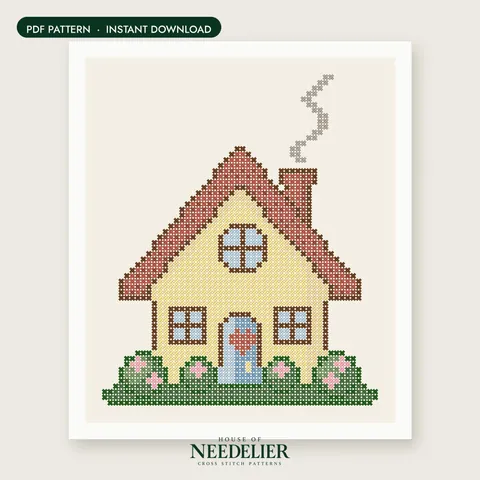
What size? Choose a hoop an inch or two bigger than the design, so the whole piece fits inside and the rings never sit on finished stitches. A 5–6 inch (13–15 cm) hoop suits most minis, like our Little Cottage at about 3.6 × 4.3 inches on 14 ct. The fabric must also reach at least an inch (2.5 cm) beyond the hoop all round so the rings can grip it.
Above about 7–8 inches, a hoop that holds the whole design gets awkward, so you move a smaller one around – fine if you're gentle, but a frame is often nicer.
Q-snaps
A Q-snap, or snap frame, is a square or rectangle of plastic tubes. You lay the fabric over it and press a half-round clamp onto each side, then roll the clamps slightly outward to tighten. It holds the fabric evenly on all four sides, it's light, and the clamps press flatter than a hoop ring – so it's popular for medium and large designs that you move around as you go. The tension isn't quite as tight as a well-adjusted hoop, but on Aida it's plenty.
Scroll frames
A scroll frame has two rollers joined by side bars. The fabric is tacked or stitched to a strip of webbing on each roller and rolled until it's taut. The width of the fabric has to fit the rollers; the length can be anything, because the finished part rolls up out of the way.
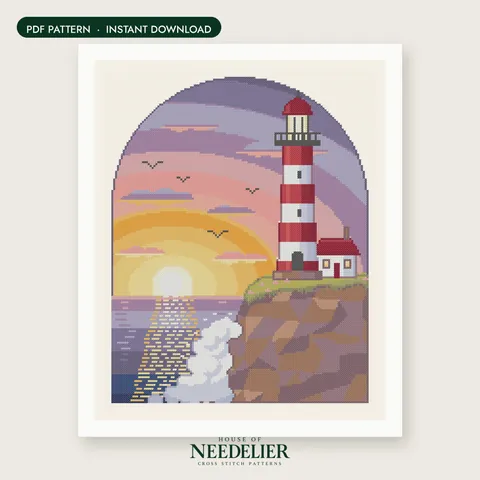
Scroll frames give the most even tension of all, and many fit a lap or floor stand so both hands are free. Setting one up takes a little time, but it pays off on a piece you'll work on for months, like our Lighthouse at Sunset at about 9.6 × 12.1 inches (24.3 × 30.8 cm) on 14 ct. For extra side tension, some stitchers lace the fabric edges to the side bars with strong thread.
Stitching in hand
Without a hoop you use the sewing method: the needle goes down and back up in one scooping movement. It's quick, portable and leaves no marks, but even tension takes practice, so it suits small pieces on Aida best.
How to get drum-tight tension
Aim for fabric that's taut like a drum – it springs back when you tap it – without stretching the weave out of shape.
- Loosen the screw and lay the fabric over the inner ring, design area centered.
- Press the outer ring down over it, with the screw where it won't catch your thread.
- Gently pull the fabric tight a little at a time all round, straight along the grain – never on the diagonal.
- Tighten the screw and check that the rows of holes still run straight. If they curve or the squares look like diamonds, loosen and start again.
- Re-tighten whenever the fabric starts to sag.
With a Q-snap, roll the clamps outward a little at a time on opposite sides. With a scroll frame, turn the rollers in opposite directions and tighten the knobs. Tight fabric works best with the stab method: needle straight down to the back, then straight up to the front, in two movements.
How to avoid hoop marks
A hoop left on fabric for days can leave a ring of creases and squashed stitches that's hard to remove.
- Take the fabric out of the hoop at the end of every session. This is the big one – and take the clamps off a Q-snap too.
- Choose a hoop larger than the design where you can.
- If you must hoop over stitches, don't overtighten.
- Keep your hands clean; dust and hand oils collect where the rings sit.
Most light marks come out with a gentle wash and press at the end – see washing, pressing and framing.
Which one should I choose?
- Small designs and minis (up to about 6 inches): a hoop 1–2 inches bigger than the design (usually 5–8 inch), or stitch in hand.
- Medium designs (about 6–9 inches): a 10–11 inch hoop, or – more comfortably – a Q-snap you move around the design.
- Large designs: a Q-snap moved around the fabric, or a scroll frame on a stand. See how to stitch large cross stitch patterns.
- Travel: a small hoop or stitching in hand.
Whichever you choose, cut enough fabric for it: see how much fabric you need.
Next: What size needle for cross stitch?.
Frequently asked questions
What size hoop should I use for cross stitch?
Choose a hoop an inch or two larger than the design so the whole piece fits inside. For most small designs a 5–6 inch hoop is ideal; larger designs are easier on a Q-snap or scroll frame.
Should I leave my cross stitch in the hoop?
No – take it out at the end of each session. Left in a hoop for days, the fabric can keep a ring of creases and squashed stitches that may not fully wash out.
Is a Q-snap better than a hoop?
Neither is better overall. A hoop gets the fabric a little tighter and suits small designs; a Q-snap holds a larger area evenly and presses less on finished stitches, so many stitchers prefer it for big pieces.
Can you cross stitch without a hoop?
Yes. Aida is stiff enough to stitch in hand using the sewing method, and it leaves no marks.
How tight should cross stitch fabric be in a hoop?
Taut like a drum, so it springs back when you tap it, but not so tight that the rows of holes bend. Pull straight along the grain, never on the diagonal.